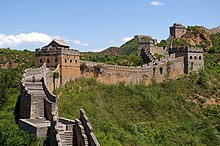
The Great Wall of China is a series of fortifications made of stone, brick, tamped earth, wood, and other materials, generally built along an east-to-west line across the historical northern borders of China to protect the Chinese states and empires against the raids and invasions of the various nomadic groups of the Eurasian Steppe. Several walls were being built as early as the 7th century bce; these, later joined together and made bigger and stronger, are now collectively referred to as the Great Wall.Especially famous is the wall built 220–206 bce by Qin Shi Huang, the first Emperor of China. Little of that wall remains. Since then, the Great Wall has on and off been rebuilt, maintained, and enhanced; the majority of the existing wall is from the Ming Dynasty.
Other purposes of the Great Wall have included border controls, allowing the imposition of duties on goods transported along the Silk Road, regulation or encouragement of trade and the control of immigration and emigration. Furthermore, the defensive characteristics of the Great Wall were enhanced by the construction of watch towers, troop barracks, garrison stations, signaling capabilities through the means of smoke or fire, and the fact that the path of the Great Wall also served as a transportation corridor.
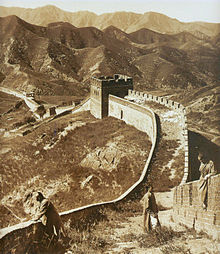
The Great Wall stretches from Dandong in the east, to Lop Lake in the west, along an arc that roughly delineates the southern edge of Inner Mongolia. A comprehensive archaeological survey, using advanced technologies, has concluded that the Ming walls measure 8,850 km (5,500 mi).This is made up of 6,259 km (3,889 mi) sections of actual wall, 359 km (223 mi) of trenches and 2,232 km (1,387 mi) of natural defensive barriers such as hills and rivers. Another archaeological survey found that the entire wall with all of its branches measure out to be 21,196 km (13,171 mi).
The collection of fortifications now known as "The Great Wall of China" has historically had a number of different names in both Chinese and English.
In Chinese histories, the term "Long Wall(s)" (長城, changcheng) appears in Sima Qian's Records of the Grand Historian, where it referred to both the separate great walls built between and north of the Warring States and to the more unified construction of the First Emperor. The Chinese character 城 is a phono-semantic compound of the "place" or "earth" radical 土 and 成, whose Old Chinese pronunciation has been reconstructed as *deŋ. It originally referred to the rampart which surrounded traditional Chinese cities and was used by extension for these walls around their respective states; today, however, it is much more often simply the Chinese word for "city".

The current Chinese name "Ten-Thousand-Mile Long Wall" (萬里長城, Wanli Changcheng) came from Sima Qian's description of it in the Records, though he did not name the walls as such. The ad 493 Book of Song quotes the frontier general Tan Daoji referring to "the long wall of 10,000 miles", closer to the modern name, but the name rarely features in pre-modern times otherwise. The traditional Chinese mile (里, lǐ) was an often irregular distance that was intended to show the length of a standard village and varied with terrain but was usually standardized at distances around a third of an English mile. Since China's metrication in 1930, it has been exactly equivalent to (500 metres or 1,600 feet),which would make the wall's name describe a distance of 5,000 kilometres (3,100 mi). However, this use of "ten-thousand" (wàn) is figurative in a similar manner to the Greek and English myriad and simply means "innumerable" or "immeasurable".
Because of the wall's association with the First Emperor's supposed tyranny, the Chinese dynasties after Qin usually avoided referring to their own additions to the wall by the name "Long Wall". Instead, various terms were used in medieval records, including "frontier(s)" (塞, sāi),"rampart(s)" (垣, yuán), "barrier(s)" (障, zhàng), "the outer fortresses" (外堡, wàibǎo), and "the border wall(s)" (t 邊牆, s 边墙, biānqiáng). Poetic and informal names for the wall included "the Purple Frontier" (紫塞, Zǐsāi) and "the Earth Dragon" (t 土龍, s 土龙, Tǔlóng). Only during the Qing period did "Long Wall" become the catch-all term to refer to the many border walls regardless of their location or dynastic origin, equivalent to the English "Great Wall".

The current English name evolved from accounts of "the Chinese wall" from early modern European travelers. By the 19th century, "The Great Wall of China" had become standard in English, French, and German, although other European languages continued to refer to it as "the Chinese wall".
Although a formal definition of what constitutes a "Great Wall" has not been agreed upon, making the full course of the Great Wall difficult to describe in its entirety, the course of the main Great Wall line following Ming constructions can be charted.
The Jiayu Pass, located in Gansu province, is the western terminus of the Ming Great Wall. Although Han fortifications such as Yumen Pass and the Yang Pass exist further west, the extant walls leading to those passes are difficult to trace. From Jiayu Pass the wall travels discontinuously down the Gansu Corridor and into the deserts of Ningxia, where it enters the western edge of the Yellow River loop at Yinchuan. Here the first major walls erected during the Ming dynasty cuts through the Ordos Desert to the eastern edge of the Yellow River loop. There at Piantou Pass (t 偏頭關, s 偏头关, Piāntóuguān) in Xinzhou, Shanxi province, the Great Wall splits in two with the "Outer Great Wall" (t 外長城, s 外长城, Wài Chǎngchéng) extending along the Inner Mongolia border with Shanxi into Hebei province, and the "inner Great Wall" (t 內長城, s 內长城, Nèi Chǎngchéng) running southeast from Piantou Pass for some 400 kilometers (250 mi), passing through important passes like the Pingxing Pass and Yanmen Pass before joining the Outer Great Wall at Sihaiye (四海冶, Sìhǎiyě), in Beijing's Yanqing County.
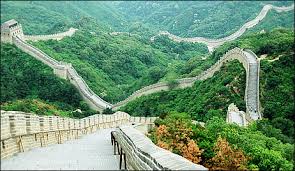
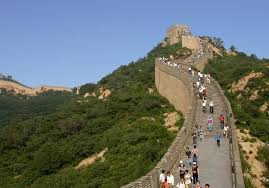
The sections of the Great Wall around Beijing municipality are especially famous: they were frequently renovated and are regularly visited by tourists today. The Badaling Great Wall near Zhangjiakou is the most famous stretch of the Wall, for this is the first section to be opened to the public in the People's Republic of China, as well as the showpiece stretch for foreign dignitaries. South of Badaling is the Juyong Pass; when used by the Chinese to protect their land, this section of the wall had many guards to defend China’s capital Beijing. Made of stone and bricks from the hills, this portion of the Great Wall is 7.8 meters (26 ft) high and 5 meters (16 ft) wide.
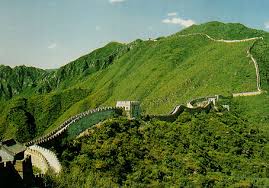
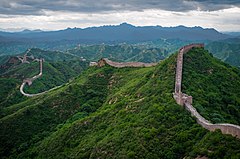
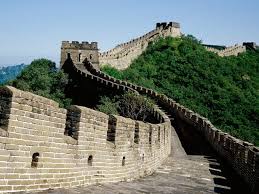
One of the most striking sections of the Ming Great Wall is where it climbs extremely steep slopes in Jinshanling. There it runs 11 kilometers (6.8 mi) long, ranges from 5 to 8 meters (16 to 26 ft) in height, and 6 meters (20 ft) across the bottom, narrowing up to 5 meters (16 ft) across the top. Wangjinglou (t 望京樓, s 望京楼, Wàngjīng Lóu) is one of Jinshanling's 67 watchtowers, 980 meters (3,220 ft) above sea level. Southeast of Jinshanling is the Mutianyu Great Wall which winds along lofty, cragged mountains from the southeast to the northwest for approximately 2.25 kilometers (about 1.3 miles). It is connected with Juyongguan Pass to the west and Gubeikou to the east. This section was one of the first to be renovated following the turmoil of the Cultural Revolution.
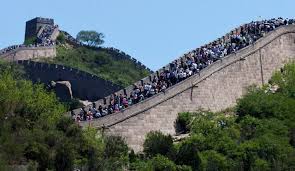
At the edge of the Bohai Gulf is Shanhai Pass, considered the traditional end of the Great Wall and the "First Pass Under Heaven". The part of the wall inside Shanhai Pass that meets the sea is named the "Old Dragon Head". 3 kilometers (1.9 mi) north of Shanhai Pass is Jiaoshan Great Wall (焦山長城), the site of the first mountain of the Great Wall. 15 kilometers (9.3 mi) northeast from Shanhaiguan is Jiumenkou (t 九門口, s 九门口, Jiǔménkǒu), which is the only portion of the wall that was built as a bridge. Beyond Jiumenkou, an offshoot known as the Liaodong Wall continues through Liaoning province and terminates at the Hushan Great Wall, in the city of Dandong near the North Korean border.
In 2009, 180 km of previously unknown sections of the wall concealed by hills, trenches and rivers were discovered with the help of infrared range finders and GPS devices.In March and April 2015 nine sections with a total length of more than 10 km (6.2 mi), believed to be part of the Great Wall, were discovered along the border of Ningxia autonomous region and Gansu province.
Before the use of bricks, the Great Wall was mainly built from rammed earth, stones, and wood. During the Ming, however, bricks were heavily used in many areas of the wall, as were materials such as tiles, lime, and stone. The size and weight of the bricks made them easier to work with than earth and stone, so construction quickened. Additionally, bricks could bear more weight and endure better than rammed earth. Stone can hold under its own weight better than brick, but is more difficult to use. Consequently, stones cut in rectangular shapes were used for the foundation, inner and outer brims, and gateways of the wall. Battlements line the uppermost portion of the vast majority of the wall, with defensive gaps a little over 30 cm (12 in) tall, and about 23 cm (9.1 in) wide. From the parapets, guards could survey the surrounding land.Communication between the army units along the length of the Great Wall, including the ability to call reinforcements and warn garrisons of enemy movements, was of high importance. Signal towers were built upon hill tops or other high points along the wall for their visibility. Wooden gates could be used as a trap against those going through. Barracks, stables, and armories were built near the wall's inner surface.
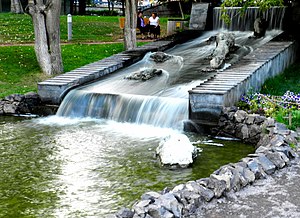 Lovers' Park (Armenian: Սիրահարների Այգի (Siraharneri Aygi)) is a public park in Yerevan, Armenia, located on Baghramyan Avenue. It occupies an area of 2.5 hectares in the central Kentron district of the city. The park was entirely renovated between 2005 and 2008 and reopened in November 2008 by the efforts of benefactor Albert Boghossian, head of Boghossian Foundation.
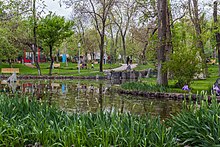 After the World War II, the park was redesigned in 1949 and renamed Pushkin Park by the decision of the Council of Ministers of the Armenian Soviet Socialist Republic, as part of the celebration of the 150th anniversary of the birth of the renowned Russian poet Alexander Pushkin. Later in 1970, the park was named Barekamutyun (Frinedship) as a tribute to the friendship of all Soviet Union member nations. In 1995, following the independence of the Republic of Armenia, by the decision of the presidency of Yerevan City Council’s civil representatives, the park was renamed Lovers' Park Yerevan, based on the fact that the park had been a favorite rendezvous for many couples, during the second half of the 20th century.
 In 2005, by the initiative of benefactor Albert Boghossian, the Boghossian Foundation assumed the renovation of the park, within the frames of Boghossian Gardens project. Following a year of research, French designer architect Pierre Rambach presented the sketches of the new Lovers' Park project in 2006 and received the approval of the Yerevan City Council. Pierre Rambach has visited Armenia several times to explore Armenian landscapes and find the best solutions to enable the combination of rigorous Japanese landscaping principles with the spirit of Armenia.
 After being entirely renovated between 2005 and 2008, the Lovers' Park Yerevan was opened in November 2008. The park has no steps in order to enable an easy access of wheelchairs to all parts. It has a small café with many outdoor seats. The park is home to a small central amphitheatre with a capacity of 215 seats and a stage surface of 100 m². The following events are held in the park: