Saturday, 2 January 2016

Abelia plants

Abelia mosanensis 2015-05-29 OB 338.jpg
Abelia  is a genus of about 30 species and many hybrids in the honeysuckle family Caprifoliaceae. Some authors, including the Angiosperm Phylogeny Group, consider Abelia and related genera to belong instead in the segregate family Linnaeaceae, also including such genera as Linnaea, Abelia, Dipelta, Kolkwitzia, and Zabelia, but not such others as Lonicera or Symphoricarpos, included by them instead in a more narrowly viewed Caprifoliaceae.


Abelias are shrubs from 1–6 m tall, native to eastern Asia (Japan west to the Himalaya) and southern North America (Mexico); the species from warm climates are evergreen, and colder climate species deciduous. The leaves are opposite or in whorls of three, ovate, glossy, dark green, 1.5–8 cm long, turning purplish-bronze to red in autumn in the deciduous species. The flowers appear in the upper leaf axils and stem ends, 1-8 together in a short cyme; they are pendulous, white to pink, bell-shaped with a five-lobed corolla, 1–5 cm long, and usually scented. Flowering continues over a long and continuous period from late spring to fall.

Type species of this genus is Abelia chinensis. The generic name commemorates Clarke Abel, a keen naturalist who accompanied Lord Amherst's unsuccessful embassy to China in 1816 as surgeon, under the sponsorship of Sir Joseph Banks. All of Abel's seeds and plants were lost in a shipwreck on the homeward voyage, however; living plants of Abelia chinensis were first imported to England in 1844 by Robert Fortune, who introduced A. uniflora the following year.

The showy semi-hardy Mexican A. floribunda of the Cordillera of Oaxaca was introduced to English horticulture in 1841

Friday, 1 January 2016

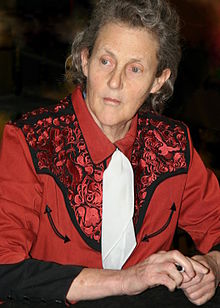
Mary Temple Grandin - American professor of animal science

TempleGrandin.jpg
Mary Temple Grandin (born August 29, 1947) is an American professor of animal science at Colorado State University, best-selling author, autism activist and consultant to the livestock industry on animal behavior. She is the inventor of the "hug box", a device to calm those on the autism spectrum. In the 2010 Time 100 list of the one hundred most influential people in the world, she was named in the "Heroes" category. She was the subject of the award-winning, biographical film, Temple Grandin.Grandin was born in Boston, Massachusetts, to Eustacia Cutler and Richard Grandin. Although she was diagnosed with autism in 1951 at the age of four, she was labeled with brain damage and placed early in a structured nursery school. When a doctor suggested speech therapy for Grandin, her mother hired a nanny to assist in the child's development. The nanny would spend hours playing turn-taking games with Grandin and her sister.


Her speech development delayed, Grandin did not begin talking until she was three and a half years old. She considers herself fortunate to have had supportive mentors from elementary school onward. Even so, Grandin states that junior high and high school were the most unpleasant times of her life due to her poor conversational skills. She was the "nerdy kid" whom everyone ridiculed. At times, while she walked down the hallways, her fellow students would taunt her by saying "tape recorder" because of her habit of repetitive speech. Grandin states, "I could laugh about it now, but back then it really hurt."

After she graduated in 1966 from Hampshire Country School, a boarding school for gifted children in Rindge, New Hampshire, Grandin went on to earn her bachelor's degree in psychology from Franklin Pierce College in 1970, a master's degree in animal science from Arizona State University in 1975, and a doctoral degree in animal science from the University of Illinois at Urbana-Champaign in 1989.
Grandin is a prominent and widely cited proponent of the rights of people with autism and of animal welfare.

She has lectured widely about her first-hand experiences of the anxiety of feeling threatened by everything in her surroundings, and of being dismissed and feared, which motivates her work in humane livestock handling processes. She studied the behavior of cattle, how they react to ranchers, movements, objects and light. Grandin then designed adapted curved corrals, intended to reduce stress, panic and injury in animals being led to slaughter.

Her business website promotes improvement of standards for slaughterhouses and livestock farms. In 2004, she won a "Proggy" award in the "Visionary" category, from People for the Ethical Treatment of Animals.

One of her notable essays about animal welfare is "Animals Are Not Things", in which she posits that technically, animals are property in our society, but the law ultimately gives them ethical protections or rights. She compares the properties and rights of owning cows, versus owning screwdrivers, enumerating how both may be used to serve human purposes in many ways, but when it comes to inflicting pain, there is a vital distinction between such "properties": legally a person can smash or grind up a screwdriver, but cannot torture an animal legally.

Grandin became well-known after being described by Oliver Sacks in the title narrative of his book An Anthropologist on Mars (1995), for which he won a Polk Award; the title is derived from Grandin's description of how she feels around neurotypical people. She first spoke in public about autism in the mid-1980s, at the request of Ruth C. Sullivan, one of the founders of the Autism Society of America (ASA). Sullivan writes:

I first met Temple in the mid-1980s  annual  conference. Standing on the periphery of the group was a tall young woman who was obviously interested in the discussions. She seemed shy and pleasant, but mostly she just listened. I learned her name was Temple Grandin. It wasn't until later in the week that I realized she was someone with autism. I approached her and asked if she'd be willing to speak at the next year's  conference. She agreed. The next year Temple first addressed an  audience. People were standing at least three deep. The audience couldn't get enough of her. Here, for the first time, was someone who could tell us from her own experience, what it was like to be extremely sound sensitive ("like being tied to the rail and the train's coming"). She was asked many questions: "Why does my son do so much spinning?" "Why does he hold his hands to his ears?" "Why doesn't he look at me?" She spoke from her own experience, and her insight was impressive. There were tears in more than one set of eyes that day. Temple quickly became a much sought-after speaker in the autism community.

Based on personal experience, Grandin advocates early intervention to address autism and supportive teachers, who can direct fixations of the child with autism in fruitful directions. She has described her hypersensitivity to noise and other sensory stimuli. She claims she is a primarily visual thinker and has said that words are her second language. Temple attributes her success as a humane livestock facility designer to her ability to recall detail, which is a characteristic of her visual memory. Grandin compares her memory to full-length movies in her head, that may be replayed at will, allowing her to notice small details. She also is able to view her memories using slightly different contexts by changing the positions of the lighting and shadows.

Her insight into the minds of cattle has taught her to value the changes in details to which animals are particularly sensitive and to use her visualization skills to design thoughtful and humane animal-handling equipment. She was named a fellow of the American Society of Agricultural and Biological Engineers in 2009.

As a partial proponent of neurodiversity, Grandin has expressed that she would not support a cure of the entirety of the autism spectrum.

In 2012, when the American beef industry was struggling with public perception of its use and sale of pink slime, Grandin spoke out in support of the food product. She said, “It should be on the market. It should be labeled. We should not be throwing away that much beef."

Aaliyah Dana Haughton - American singer, dancer, actress, and model

1997 Los Angeles Aaliyah Next Generation Jeans Tommy Hilfiger Ad Shoot Photo by Alex Berline.jpg
Aaliyah Dana Haughton  (January 16, 1979 – August 25, 2001) was an American singer, dancer, actress, and model. She was born in Brooklyn, New York, and raised in Detroit, Michigan. At the age of 10, she appeared on the television show Star Search and performed in concert alongside Gladys Knight. At age 12, Aaliyah signed with Jive Records and her uncle Barry Hankerson's Blackground Records. Hankerson introduced her to R. Kelly, who became her mentor, as well as lead songwriter and producer of her debut album, Age Ain't Nothing but a Number. The album sold three million copies in the United States and was certified double platinum by the Recording Industry Association of America (RIAA). After facing allegations of an illegal marriage with R. Kelly, Aaliyah ended her contract with Jive and signed with Atlantic Records.


Aaliyah worked with record producers Timbaland and Missy Elliott for her second album, One in a Million; it sold 3 million copies in the United States and over eight million copies worldwide. In 2000, Aaliyah appeared in her first film, Romeo Must Die. She contributed to the film's soundtrack, which spawned the single "Try Again". The song topped the Billboard Hot 100 solely on airplay, making Aaliyah the first artist in Billboard history to achieve this goal. "Try Again" earned Aaliyah a Grammy Award nomination for Best Female R&B Vocalist. After completing Romeo Must Die, Aaliyah filmed her role in Queen of the Damned. She released her third and final album, Aaliyah, in July 2001.

On August 25, 2001, Aaliyah and eight others were killed in a plane crash in the Bahamas after filming the music video for the single "Rock the Boat". The pilot, Luis Morales III, was unlicensed at the time of the accident and had traces of cocaine and alcohol in his system. Aaliyah's family later filed a wrongful death lawsuit against Blackhawk International Airways, which was settled out of court. Aaliyah's music has continued to achieve commercial success with several posthumous releases. Aaliyah has sold an estimate of 24 to 32 million albums worldwide. She has been credited for helping redefine contemporary R&B, pop and hip hop, earning her the nicknames "Princess of R&B" and "Queen of Urban Pop". She is listed by Billboard as the tenth most successful female R&B artist of the past 25 years and 27th most successful R&B artist in history.
Aaliyah began to work on her second film, Queen of the Damned. She played the role of an ancient vampire, Queen Akasha, which she described as a "manipulative, crazy, sexual being". Prior to her death, she expressed the possibility of recording songs for the film's soundtrack and welcomed the possibility of collaborating with Jonathan Davis. She was scheduled to film for the sequels of The Matrix as the character Zee.

In May 2001, Shaquille O'Neal admitted that his remarks where he claimed to have engaged in sexual intercourse with Aaliyah, Cindy Crawford and Venus Williams were false after making the allegations during an appearance on a radio station and apologized to the three. All three denied the claims. The following month, June 2001, Aaliyah posed for a photo shoot with Eric Johnson. Johnson kept the images in his "private personal archive" for thirteen years before providing digital copies of 13 Aaliyah photographs to an online photography magazine and authorizing the publication to use the photographs for a story they were doing on Aaliyah. Not long after, he filed a lawsuit claiming ABC had infringed his rights since the corporation authorized further reproduction by reproducing them online.

Aaliyah released her self-titled album, Aaliyah, in July 2001. It debuted at number two on the Billboard 200, selling 187,000 copies in its first week.[64] The first single from the album, "We Need a Resolution", peaked at number 59 on the Billboard Hot 100. She finished recording the album in March 2001after a year of recording tracks that began in March of the previous year. At the time she started recording the album, Aaliyah's publicist disclosed the album's release date as most likely being in October 2000. Filming for Queen of the Damned delayed the release of Aaliyah. Aaliyah enjoyed balancing her singing and acting careers. Though she called music a "first" for her, she also had been acting since she was young and had wanted to begin acting "at some point in my career," but "wanted it to be the right time and the right vehicle" and felt Romeo Must Die "was it".

Aaliyah was released five years after One in a Million. Aaliyah had not intended for the albums to have such a gap between them. "I wanted to take a break after One in a Million to just relax, think about how I wanted to approach the next album. Then, when I was ready to start back up, "Romeo" happened, and so I had to take another break and do that film and then do the soundtrack, then promote it. The break turned into a longer break than I anticipated." Connie Johnson of the Los Angeles Times argued that Aaliyah having to focus on her film career may have caused her to not give the album "the attention it merited."Collaborator Timbaland concurred, stating that he was briefly in Australia to work on the album while Aaliyah was filming and did not feel the same production had gone into Aaliyah as One in a Million had. He also said Virgin Records had rushed the album and Aaliyah had specifically requested Missy Elliott and Timbaland work on Aaliyah with her.

The week after Aaliyah's death, her third studio album, Aaliyah, rose from number 19 to number one on the Billboard 200. "Rock the Boat" was released as a posthumous single. The music video premiered on BET's Access Granted; it became the most viewed and highest rated episode in the history of the show.The song peaked at number 14 on the Billboard Hot 100 and number two on the Billboard Hot R&B/Hip-Hop Songs chart. It was also included on the Now That's What I Call Music! 8 compilation series; a portion of the album's profits was donated to the Aaliyah Memorial Fund.Promotional posters for Aaliyah that had been put up in major cities such as New York and Los Angeles became makeshift memorials for grieving fans.

"More than a Woman" and "I Care 4 U" were released as posthumous singles and peaked within the top 25 of the Billboard Hot 100.The album was certified double Platinum by the RIAA and sold 2.95 million copies in the United States. "More than a Woman" reached number one on the UK singles chart making Aaliyah the first deceased artist to reach number one on the UK singles chart. "More than a Woman" was replaced by George Harrison's "My Sweet Lord" which is the only time in the UK singles chart's history where a dead artist has replaced another dead artist at number one. In July 2001, she allowed MTV's show Diary behind-the-scenes access to her life and stated "I am truly blessed to wake up every morning to do something that I love; there is nothing better than that." She continued, "Everything is worth it – the hard work, the times when you're tired, the times when you are a bit sad. In the end, it's all worth it because it really makes me happy. I wouldn't trade it for anything else in the world. I've got good friends, a beautiful family and I've got a career. I thank God for his blessings every single chance I get."

Aaliyah was signed to appear in several future films, including Honey,a romantic film titled Some Kind of Blue, and a Whitney Houston-produced remake of the 1976 film Sparkle. Whitney Houston recalled Aaliyah being "so enthusiastic" about the film and wanting to appear in the film "so badly". Houston also voiced her belief that Aaliyah was more than qualified for the role and the film was shelved after she died, since Aaliyah had "gone to a better place". Studio officials of Warner Brothers stated that Aaliyah and her mother had both read the script for Sparkle. According to them, Aaliyah was passionate about playing the lead role of a young singer in a girl group. The film was released in 2012, eleven years after Aaliyah's death. Before her death, Aaliyah had filmed part of her role in The Matrix Reloaded and was scheduled to appear in The Matrix Revolutions as Zee.Aaliyah told Access Hollywood that she was "beyond happy" to have landed the role. The role was subsequently recast to Nona Gaye. Aaliyah's scenes were included in the tribute section of the Matrix Ultimate Collection series.

In November 2001, Ronald Isley stated that Aaliyah and the Isley Brothers had discussed a collaboration prior to her death. She had previously covered the Isley Brothers' single "At Your Best (You Are Love)". By 2001, Aaliyah had enjoyed her now seven-year career and felt a sense of accomplishment. "This is what I always wanted," she said of her career in Vibe magazine. "I breathe to perform, to entertain, I can't imagine myself doing anything else. I'm just a really happy girl right now. I honestly love every aspect of this business. I really do. I feel very fulfilled and complete.

James Joseph Brown- American singer, songwriter, record producer, dancer and bandleader.


James Joseph Brown(May 3, 1933 – December 25, 2006) was an American singer, songwriter, record producer, dancer and bandleader. The founding father of funk music and a major figure of 20th century popular music and dance, he is often referred to as the "Godfather of Soul". In a career that spanned six decades, Brown influenced the development of several music genres.


Brown began his career as a gospel singer in Toccoa, Georgia. Joining an R&B vocal group called the Avons that later evolved to become the Flames, Brown served as the group's lead singer. First coming to national public attention in the late 1950s as a member of the singing group the Famous Flames with the hit ballads "Please, Please, Please" and "Try Me", Brown built a reputation as a tireless live performer with the Famous Flames and his backing band, sometimes known as the James Brown Band or the James Brown Orchestra. Brown's success peaked in the 1960s with the live album Live at the Apollo and hit singles such as "Papa's Got a Brand New Bag", "I Got You (I Feel Good)" and "It's a Man's Man's Man's World". During the late 1960s, Brown moved from a continuum of blues and gospel-based forms and styles to a profoundly "Africanized" approach to music-making that influenced the development of funk music. By the early 1970s, Brown had fully established the funk sound after the formation of the J.B.s with records such as "Get Up (I Feel Like Being a) Sex Machine" and "The Payback". Brown also became notable for songs of social commentary, including the 1968 hit "Say It Loud - I'm Black and I'm Proud". Brown continued to perform and record until his death in 2006 from congestive heart failure.

Brown recorded 16 singles that peaked at number-one on the Billboard R&B charts. Brown also holds the record for the most singles listed on the Billboard Hot 100 chart which did not reach number-one. Brown has been honored by many institutions including inductions into the Rock and Roll Hall of Fame and Songwriters Hall of Fame.[10] In Joel Whitburn's analysis of the Billboard R&B charts from 1942 to 2010, James Brown is ranked as number one in The Top 500 Artists. Brown is ranked seventh on the music magazine Rolling Stone's list of its 100 greatest artists of all time. Rolling Stone has also cited Brown as the most sampled artist of all time.
James Joseph Brown was born on May 3, 1933, in Barnwell, South Carolina, to 16-year-old Susie (née Behling; 1917–2003) and 22-year-old Joseph "Joe" Gardner Brown (1911–1993), in a small wooden shack. Brown's name was supposed to have been Joseph James Brown, Jr.; however, his first and middle names were mistakenly reversed on his birth certificate. Brown later legally changed his name to remove the "Jr." designation. His parents were both black; in his autobiography, Brown stated that he also had Chinese and Native American ancestry. The Brown family lived in extreme poverty in Elko, South Carolina, which was an impoverished town at the time They later moved to Augusta, Georgia, when Brown was four or five. Brown's family first settled at one of his aunts' brothels and later moved into a house shared with another aunt. Brown's mother later left the family after a contentious marriage and moved to New York. Brown spent long stretches of time on his own, hanging out in the streets and hustling to get by. Brown managed to stay in school until sixth grade.

Brown began singing in talent shows as a young child, first appearing at Augusta's Lenox Theater in 1944, winning the show after singing the ballad "So Long".While in Augusta, Brown performed buck dances for change to entertain troops from Camp Gordon at the start of World War II as their convoys traveled over a canal bridge from near his aunt's home. Brown learned how to play piano, guitar and harmonica during this period. Brown became inspired to become an entertainer after seeing footage of Louis Jordan and his Tympany Five performing "Caldonia" in a short film.During his teen years, Brown briefly had a career as a boxer. At 16, Brown was convicted of robbery and was sent to a juvenile detention center in Toccoa. Brown formed a gospel quartet with four fellow cellmates, including Johnny Terry. Stories differ as to how Brown was eventually paroled, including a story that Bobby Byrd's family had helped to secure an early release, while another stated that Brown got his parole after a car and motor manufacturing company owner, S.C. Lawson, agreed to be a sponsor after Brown had promised to look for a job guaranteed for two years. Brown was paroled on June 14, 1952.Upon his release, Brown joined a gospel group and worked at several jobs, including the Lawson Motor Company and as a janitor at a local school.Brown and Bobby Byrd reportedly met following his release from prison and the two became friends.
On December 23, 2006, Brown became very ill and arrived at his dentist's office in Atlanta, Georgia, several hours later than his appointment for dental implant work. During that visit, Brown's dentist observed that Brown looked "very bad ... weak and dazed." Instead of performing the dental work, the dentist advised Brown to see a doctor right away about his medical condition.

Brown checked in at the Emory Crawford Long Memorial Hospital the next day for a medical evaluation of his condition, and he was admitted to the hospital for observation and treatment.According to Charles Bobbit, Brown's longtime personal manager and friend, Brown had a noisy cough since he returned from a November trip to Europe. Bobbit also added that Brown never complained about being sick, and often performed while ill. Although Brown had to cancel upcoming shows in Waterbury, Connecticut and Englewood, New Jersey, Brown was confident that the doctor would discharge him from the hospital in time to perform the New Year's Eve shows. For the New Year's celebrations, Brown was scheduled to perform at the Count Basie Theatre in New Jersey and at the B. B. King Blues Club in New York, in addition to performing a song live on CNN for the Anderson Cooper New Year's Eve special.However, Brown remained hospitalized, and his medical condition worsened throughout that day.

On December 25, 2006, Brown died at approximately 1:45 am EST (06:45 UTC) from congestive heart failure resulting from complications of pneumonia, at the age of 73, with his personal manager and longtime friend Charles Bobbit at his bedside.According to Bobbit, Brown stuttered "I'm going away tonight", and then took three long, quiet breaths and fell asleep before dying.