Sunday, 13 March 2016

which fish can make electric power ?

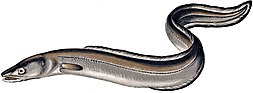
An eel is any fish belonging to the order Anguilliformes , which consists of four suborders, 20 families, 111 genera and about 800 species. Most eels are predators. The term "eel" (originally referring to the European eel) is also used for some other similarly shaped fish, such as electric eels and spiny eels, but these are not members of the Anguilliformes order.

Eels are elongated fish, ranging in length from 5 cm (2.0 in) in the one-jawed eel  to 4 m (13 ft) in the slender giant moray. Adults range in weight from 30 g (1.1 oz) to well over 25 kg (55 lb). They possess no pelvic fins, and many species also lack pectoral fins. The dorsal and anal fins are fused with the caudal fin, forming a single ribbon running along much of the length of the animal.Eels swim by generating body waves which travel the length of their bodies. They can swim backwards by reversing the direction of the wave.

Most eels live in the shallow waters of the ocean and burrow into sand, mud, or amongst rocks. A majority of eel species are nocturnal, thus are rarely seen. Sometimes, they are seen living together in holes, or "eel pits". Some species of eels also live in deeper water on the continental shelves and over the slopes deep as 4,000 m (13,000 ft). Only members of the Anguilla regularly inhabit fresh water, but they, too, return to the sea to breed.

The heaviest true eel is the European conger. The maximum size of this species has been reported as reaching a length of 3 m (10 ft) and a weight of 110 kg (240 lb). Other eels are longer, but do not weigh as much, such as the slender giant moray which reaches 4 m (13 ft).

which fish is known as 'smiling fish'?

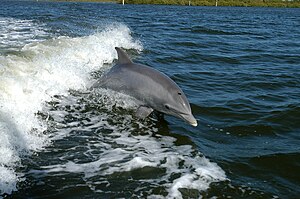
Tursiops truncatus 01.jpg
Dolphins are a widely distributed and diverse group of fully aquatic marine mammals. They are an informal grouping within the order Cetacea, excluding whales and porpoises, so to zoologists the grouping is paraphyletic. The dolphins comprise the extant families Delphinidae (the oceanic dolphins), Platanistidae (the Indian river dolphins), Iniidae (the new world river dolphins), and Pontoporiidae (the brackish dolphins). There are 40 extant species of dolphins. Dolphins, alongside other cetaceans, belong to the clade Cetartiodactyla with even-toed ungulates, and their closest living relatives are the hippopotamuses, having diverged about 40 million years ago.

Dolphins range in size from the 1.7 metres (5.6 ft) long and 50 kilograms (110 lb) Maui's dolphin to the 9.5 metres (31 ft) and 10 metric tons (11 short tons) killer whale. Several species exhibit sexual dimorphism, in that the males are larger than females. They have streamlined bodies and two limbs that are modified into flippers. Though not quite as flexible as seals, some dolphins can travel at 55.5 kilometres per hour (34.5 mph). Dolphins use their conical shaped teeth to capture fast moving prey. They have well-developed hearing − their hearing, which is adapted for both air and water, is so well developed that some can survive even if they are blind. Some species are well adapted for diving to great depths. They have a layer of fat, or blubber, under the skin to keep warm in the cold water.

Although dolphins are widespread, most species prefer the warmer waters of the tropic zones, but some, like the right whale dolphin, prefer colder climates. Dolphins feed largely on fish and squid, but a few, like the killer whale, feed on large mammals, like seals. Male dolphins typically mate with multiple females every year, but females only mate every two to three years. Calves are typically born in the spring and summer months and females bear all the responsibility for raising them. Mothers of some species fast and nurse their young for a relatively long period of time. Dolphins produce a variety of vocalizations, usually in the form of clicks and whistles.

Dolphins are sometimes hunted in places like Japan, in an activity known as dolphin drive hunting. Besides drive hunting, they also face threats from bycatch, habitat loss, and marine pollution. Dolphins have been depicted in various cultures worldwide. Dolphins occasionally feature in literature and film, as in the Warner Bros film Free Willy. Dolphins are sometimes kept in captivity and trained to perform tricks, but breeding success has been poor and the animals often die within a few months of capture. The most common dolphins kept are the killer whales and bottlenose dolphins.

who wrote the book 'History of Animals' ?

"Aristoteles" (1811) by Francesco Hayez (1791–1882)
"History of Animals" is a natural history text by the ancient Greek philosopher Aristotle, who had studied at Plato's Academy in Athens. It was written in the fourth century BC; Aristotle died in 322 BC.


Generally seen as a pioneering work of zoology, Aristotle frames his text by explaining that he is investigating the what (the existing facts about animals) prior to establishing the why (the causes of these characteristics). The book is thus an attempt to apply philosophy to part of the natural world. Throughout the work, Aristotle seeks to identify differences, both between individuals and between groups. A group is established when it is seen that all members have the same set of distinguishing features; for example, that all birds have feathers, wings, and beaks. This relationship between the birds and their features is recognized as a universal.

The History of Animals had a powerful influence on zoology for some two thousand years. It continued to be a primary source of knowledge until in the sixteenth century zoologists including Conrad Gessner, all influenced by Aristotle, wrote their own studies of the subject.

Which oxide is known as ' laughing gas' ?

Nitrous oxide, commonly known as laughing gas, nitrous, nitro, or NOS is a chemical compound with the formula N
2O. It is an oxide of nitrogen. At room temperature, it is a colourless, non-flammable gas, with a slightly sweet odour and taste. It is used in surgery and dentistry for its anaesthetic and analgesic effects. It is known as "laughing gas" due to the euphoric effects of inhaling it, a property that has led to its recreational use as a dissociative anaesthetic. It is also used as an oxidizer in rockets and in motor racing to increase the power output of engines. At elevated temperatures, nitrous oxide is a powerful oxidizer similar to molecular oxygen.

Nitrous oxide gives rise to nitric oxide (NO) on reaction with oxygen atoms, and this NO in turn reacts with ozone. As a result, it is the main naturally occurring regulator of stratospheric ozone. It is also a major greenhouse gas and air pollutant. Considered over a 100-year period, it is calculated to have between 265 and 310 times more impact per unit mass (global-warming potential) than carbon dioxide.

It is on the WHO Model List of Essential Medicines, the most important medications needed in a health system.